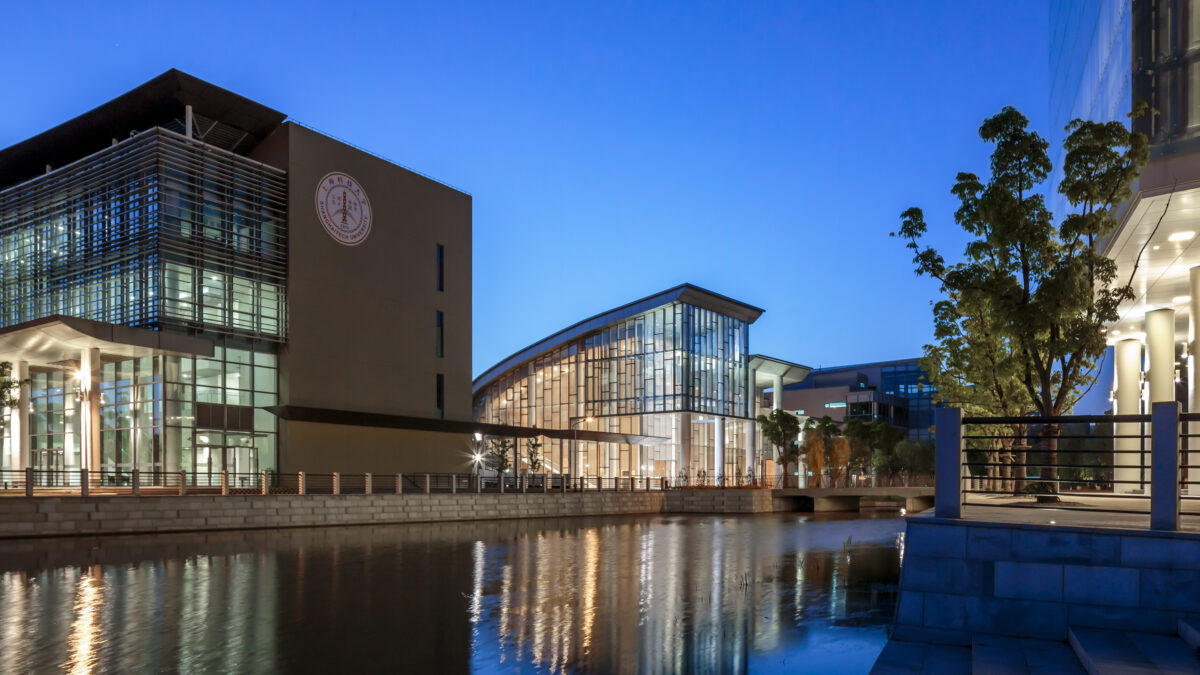
ShanghaiTech Main Auditorium

The Main Auditorium provides a highly visible destination to welcome students arriving from the academic and residential zones. The building is located prominently toward the southern end of the Village Canal Promenade – the major student pedestrian spine – and across from the Library. The design creates a sculptural, curved expression to give the building a unique iconic form within the campus. The exterior metallic cladding and form provides a streamlined, technological image that relates symbolically and appropriately to ShanghaiTech University’s academic function and mission. On the east façade, the entire Ground Floor is opened up to form a dynamic, glazed lobby under a tall arcade. The side walls on the south and north façades are also glazed, allowing abundant light and views to filter through to the interior. The interior finish surfaces feature the predominant use of wood on beams and ceiling to optimize acoustic performance while providing a warm, intimate character. In addition, the inside walls incorporate sound panels to further enhance the sound performance. The Auditorium providing key venue for academic lectures, performances and other events on the campus, with 543 seats.
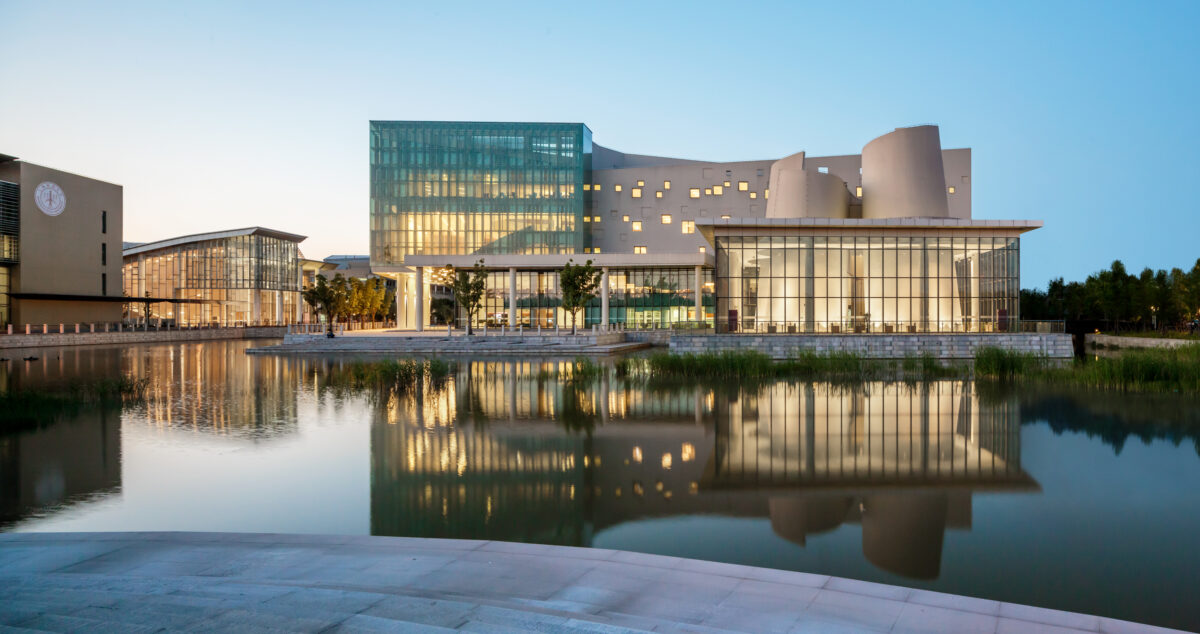
ShanghaiTech Main University Library

Iconic Gateway
Anchoring the eastern end of “The Crescent” arrival sequence at ShanghaiTech University, the Library building is configured to create a prominent, iconic gateway for visitors entering from the main south gate, while serving as a central hub of activity for the overall campus.  The library is designed to be an open learning building to promote interaction, creation, experiential learning, and discovery.

Collaborative Learning
The library features a large central atrium space that connects the spaces located on the north and south parts of the 5-floor building. Stairs and bridges are incorporated to provide fluid circulation along the interior atrium space.  Group study rooms, a makerspace/recording studio, and exhibition spaces are located on the ground and lower floors.  Quiet spaces, such as research and individual study spaces, are located on the upper floors.

“Wall of Light” Concept
The design creates a strong sense of identity with a “wall of light” concept highlighted by iconic elements at the entrances and the Lake Reading Room. A high-performance glass façade maintains openness while controlling glare with interior wood louvers and solar control roller-shades located within the double-wall cavity. The west and east entrances incorporate projected, glassy volumes that serve as “lantern” marker elements, becoming illuminated beacons of learning in the evening.

ShanghaiTech Student Center

The Student Center at ShanghaiTech University establishes its own strong presence at the Eastern Gate of the campus, creating a landmark to welcome students arriving from vehicle drop-offs and public transit, including the nearby subway station. The program achieves a vibrant focus on student life by integrating a rich mix of activities and retail spaces— bookstore, café, retail, student club space, student lounges, administrative, support spaces.  Outdoor gathering spaces include terraces, seating areas, outdoor theater and amphitheater.

24-Hour Energy and Interaction
The design configures a distinctive, elongated “landform” building providing multiple open places for seating, interaction and social gathering—grand stairs, ramps, terraces, outdoor theater and amphitheater. Horizontal and vertical movement is designed to encourage informal interaction and socializing from both the Village Promenade in the west, and the entry plaza in the east— using “social stairs,” naturally-lighted galleries, and glazed pavilions.  These elements encourage a broad array of interactions, from casual to programmed, while the varied mix of uses creates a lively, 24-hour energy.

The clear building massing concept expresses a “folded roof” incorporating an engaged sequence of two movements—going up from the grand stairs in the east to the roof-top amphitheater in the west overlooking the Promenade, and then continuing back to reach the higher mass of the student lounges above the grand stairs.  These two movement paths at different levels activate the building by providing visibility, transparency, and optimal uses of exterior and interior spaces.  A tower “campanile” acts as a marker for visitors and students while providing an exterior digital display to promote student activities.

Back to Top